Digital-services distributor · anonymised case
A POS platform connected to 20 API providers
Centralising top-up, recharge codes, bookings and eSIM for a reseller network, with balance, commission and supplier-error monitoring.
Anonymous case. No screenshots. Confidentiality.
POSAPI integrationObservabilityHigh availability
The need
A distributor wanted to equip its retail network with one POS solution. Resellers needed to sell several digital products: mobile top-ups, codes, bookings and eSIM.
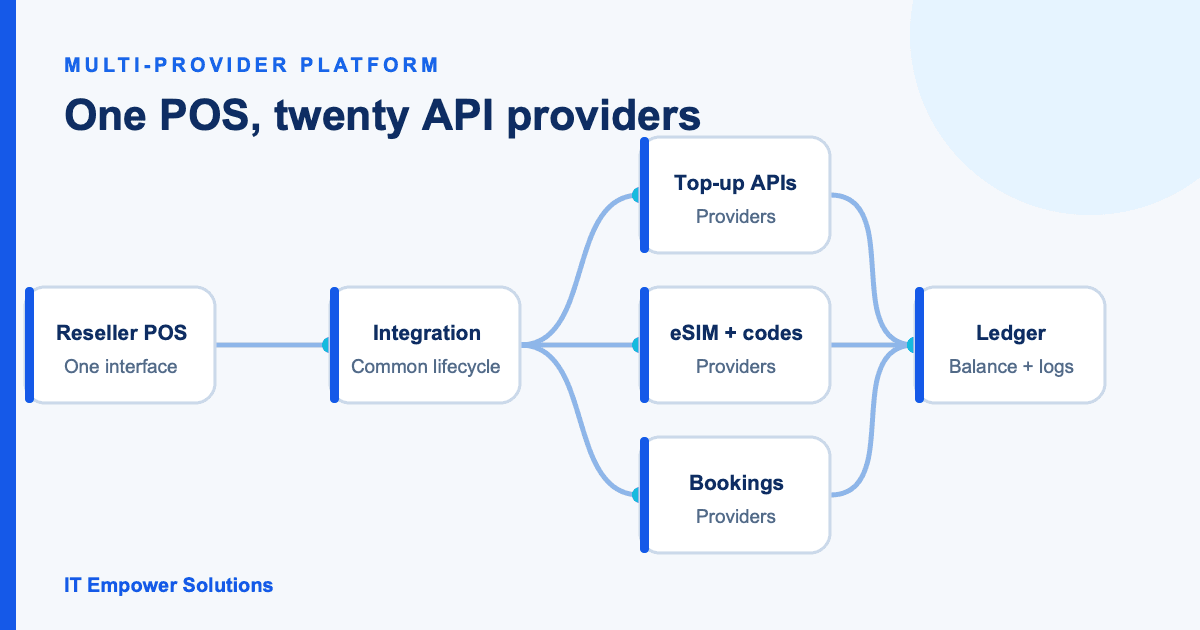
The catalogue depended on around 20 API providers. Each had its own formats, balances, response times and failure rules. Without a shared layer, stores would have needed several tools and administrators would have lacked a reliable transaction view.
Constraints
- availability during retail opening hours;
- traceability of reseller actions;
- separate balance and commission monitoring;
- investigation of third-party API failures;
- addition of products without rebuilding the POS;
- self-service logs for the administration team.
DT One, Ding and other services were integrated platforms. They were not the clients for this engagement.
Architecture
Shared integration layer
Provider-specific formats were adapted behind a consistent interface. The POS could initiate an operation without embedding every API’s details.
Traceable transaction lifecycle
Every request received an internal identifier and status. Calls, responses and status changes were logged to distinguish a local failure, supplier rejection and pending operation.
Visible balances and commissions
Dashboards gave administrators a view of supplier balances, reseller activity and commissions. Logs were accessible for first-line investigation without waiting for a developer.
Access management
Permissions separated administrators, resellers and outlets. Important actions were attributed to named accounts rather than shared identifiers.
Outcome
The network gained one entry point for products from 20 providers. Administrators could follow transactions, balances, commissions and API incidents from the same system.
Outlet count, financial volume and availability levels remain confidential. The figure of 20 describes this project’s integration scope, not a generic promise.
Why it matters
Multi-provider integration is not just a set of endpoints. Transaction state, failure recovery, reconciliation and observability must be designed from the start.
IT Empower delivers tailored IT solutions, API integration and operations. The IT assessment identifies critical flows before development begins.