Media group · anonymised case
Recovering a legacy media application and its maintenance
Knowledge transfer after a supplier departure, business-rule fixes, restarted enhancements and migration to less costly hosting.
Anonymous case. No screenshots. Confidentiality.
Legacy applicationRecoveryMaintenanceMigration
Starting point
A business application managed media plans across television, radio and web. Teams still depended on it, but maintenance had become risky: an ageing stack, an expensive Windows and Plesk environment, recurring defects and a damaged relationship with the original supplier.
Some inconsistencies affected billable amounts and media usage. Long-requested enhancements remained blocked. The first priority was not a new interface, but enough reliable knowledge to work without putting business data at further risk.
The recovery problem
The engagement combined four difficulties:
- manage a handover while the previous team was leaving;
- understand old, lightly documented code;
- fix defects in sensitive business calculations;
- reduce hosting cost without causing another interruption.
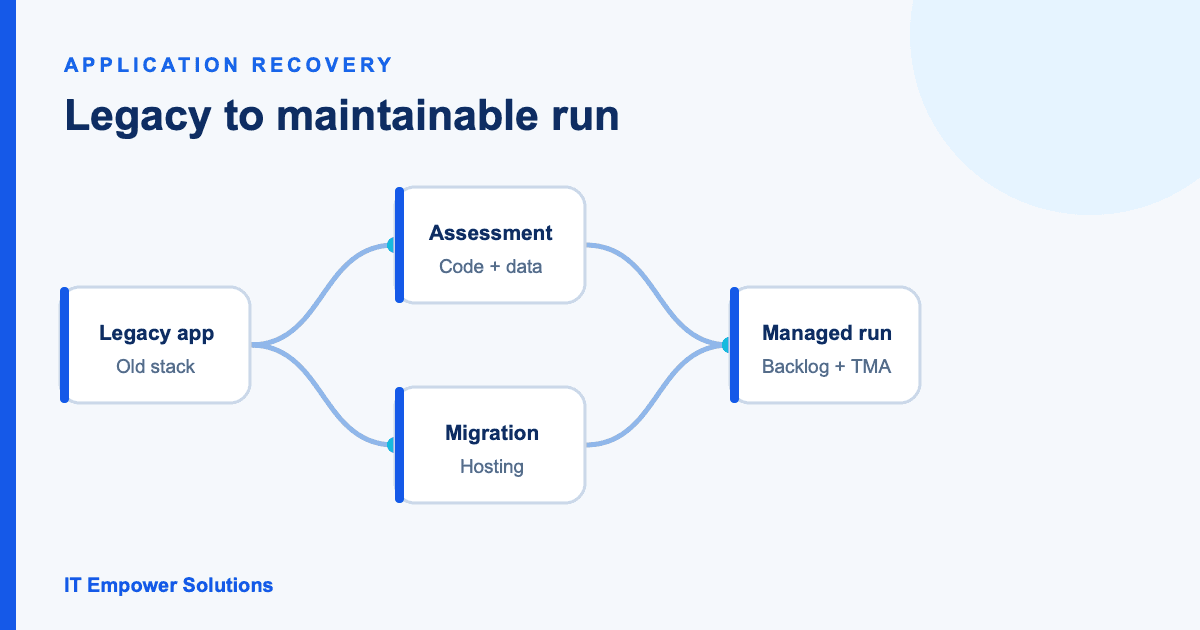
An immediate rewrite would have added functional and data migration to an already fragile project. We chose gradual recovery of the existing application.
What we did
Code and dependency assessment
We identified active components, versions actually in use, hosting dependencies and journeys that could affect billing.
Handover and knowledge reconstruction
Available information became usable documentation: access, deployment, data structure, business processing and known risks. The application no longer depended solely on the former supplier’s memory.
Defect correction
Business inconsistencies were reproduced before they were fixed. Priority went to calculations and flows that could affect billing or media usage.
Restarting enhancements
Once the foundation was stable, waiting requests were qualified and organised into a readable backlog. Incidents, technical debt and new features were handled separately.
Hosting migration
The hosting model was changed to lower recurring cost and leave an overly restrictive environment. Backup, validation and rollback were part of the migration plan.
Outcome
The organisation regained a team able to maintain the application, correct its business rules and restart enhancements. Hosting was simplified and its cost reduced. Work continued through an application-maintenance agreement with explicit scope and backlog.
Detailed figures and the client’s name remain confidential. We do not publish a reduction percentage or number of fixes without permission.
What this case shows
Legacy software does not automatically require a rewrite. When the business still depends on it, software project recovery can restore control of access, data and releases before modernisation is considered.
Facing a similar situation? The IT assessment maps the system, risks and first decisions without committing to a rewrite.